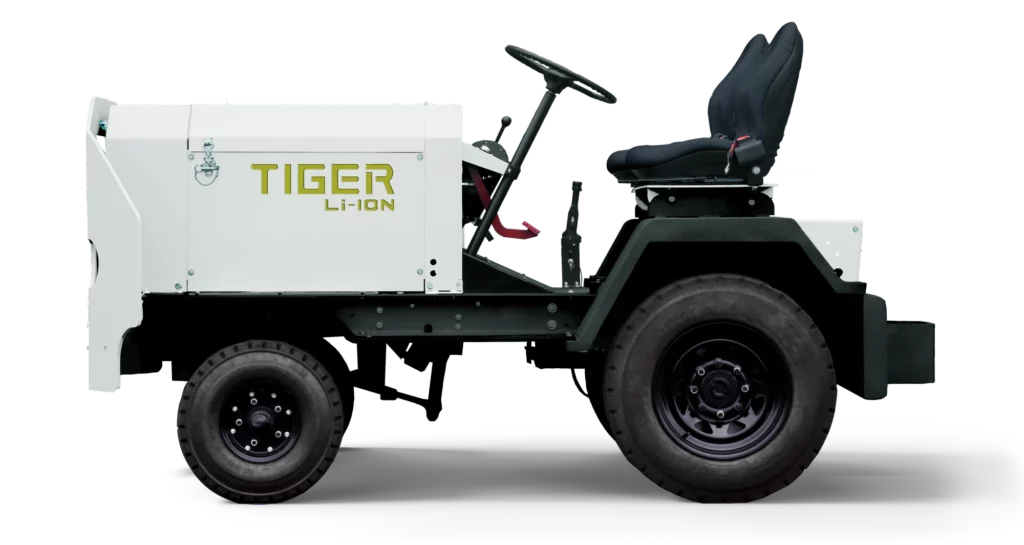
Maritime Terminals & Ports
Move Cargo & Heavy Equipment in Demanding Port Environments
Marine terminals, shipyards, cruise ports and ferry facilities run around the clock. Extreme weather, heavy loads and high equipment utilization rates demand equipment that doesn’t quit. Tiger tow tractors tackle those conditions with a 100% steel chassis, a 60,000-lb. towing capacity and an operating temperature range spanning sub-zero winter waterfront operations to summer heat on sun-exposed container aprons.

CONTAINER TERMINALS & CARGO PORTS
Moving Containers, Cargo Equipment & Terminal Vehicles on the Apron
Tiger tow tractors — in lithium-ion electric, gasoline, LPG and export diesel — tow up to 60,000 lbs of containers, trailers and cargo equipment on the apron. Tiger LPG delivers minimal emissions, making it a suitable choice for enclosed terminal buildings and covered berth areas.
However, Tiger Li-Ion gains further advantages as port operations modernize. Its zero-emission profile satisfies EPA and port authority low-emission zone requirements. Its flexible opportunity charging keeps units in rotation across multi-shift terminal operations without added downtime. The heated and insulated battery pack holds full performance on cold, exposed waterfront aprons where other electric equipment loses range. Anti-rollover technology keeps operators safe on terminal ramps and sloped berth approaches.
SHIPYARDS, CRUISE PORTS & FERRY TERMINALS
Shipyard Utility Towing, Cruise Terminal Ground Ops and Ferry Logistics
In shipyard environments, Tiger tows heavy equipment between berths and serves as a utility tractor in ship repair and outfitting operations. At cruise terminals and ferry facilities, Tiger handles a range of turnaround logistics including towing supply trains loaded with textiles, food and beverages, and transporting employees and guests in large passenger trains between parking, terminals and boarding areas.
With lithium-ion, gasoline, LPG and export diesel configurations available, Tiger matches any fuel infrastructure and operational environment. In enclosed dry-dock buildings and terminal concourses where combustion equipment is restricted, the Li-Ion’s zero-emission operation eliminates ventilation concerns and compliance risk. Where full electrification isn’t yet feasible, Tiger LPG suits semi-enclosed environments with minimal emissions. Gas and export diesel support outdoor shipyard operations, remote berths and international port facilities.
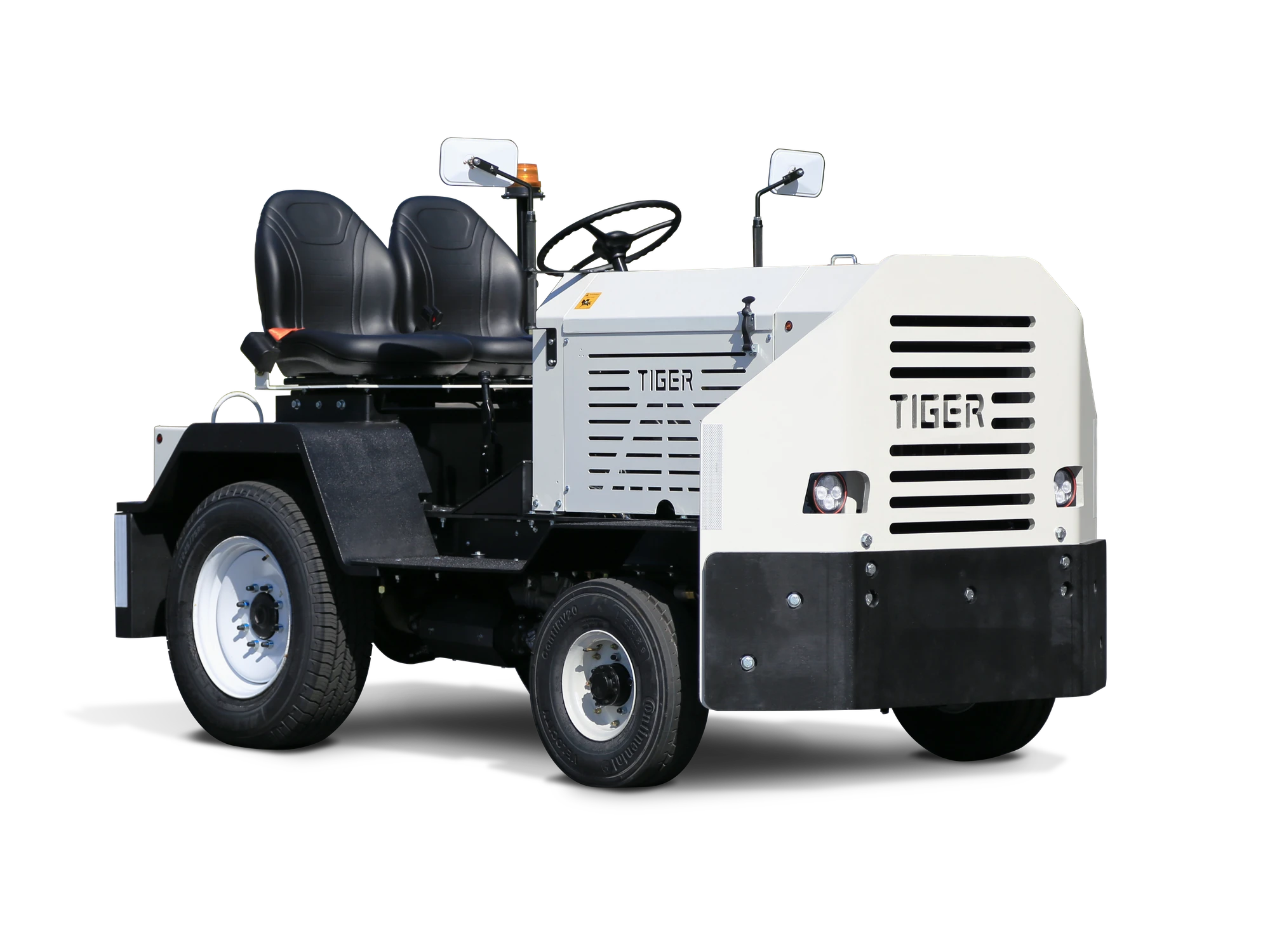
Tiger Tow Tractors Work in Maritime Operations
From container aprons to dry-dock buildings — 60,000 lbs of Heavy-Duty Towing
Container Terminals
Apron utility towing, transporting containers, shuttling trailers, yard operations and intermodal transfers. Tiger Li-Ion handles enclosed terminal buildings. Tiger Gas handles open apron areas without shore power access.
Shipyards & Dry Docks
Moving fabrication modules, towing ship sections between berths, utility towing in covered dry-dock buildings and ship repair facilities. Enclosed shipyard buildings demand zero-emission equipment — Tiger Li-Ion delivers.
Cruise Ports & Passenger Terminals
Tiger positions ground support equipment, moves gangways, manages provisioning logistics and handles terminal vehicles during the compressed turnaround window between arrivals and departures.
Ferry Terminals & Short Sea Shipping
Tiger manages vehicle and cargo logistics during rapid ferry turnarounds, positions ramp equipment and supports roll-on/roll-off operations. Tiger’s compact footprint reaches terminal areas that larger port equipment can’t enter.
Break-Bulk & Project Cargo
Tiger moves oversized project cargo, heavy lift equipment and break-bulk freight within terminal staging areas. At 60,000-lb. tow capacity, Tiger eliminates the need for dedicated heavy-lift equipment on non-containerized cargo moves.
Port Maintenance & Infrastructure
Tiger handles berth maintenance equipment moves, utility towing across terminal property and general infrastructure operations — and the Li-Ion cuts CO2 emissions from the marine environment.
Maritime & Port Tow Tractor FAQ
Common questions from operators and procurement teams evaluating Tiger tow tractors for maritime terminals, shipyards and port operations.
Have a question not answered here? Contact our Waev specialists who support the full lineup vehicles from Tiger, Taylor-Dunn, GEM and Fusion.
What tow capacity does the Tiger tractor provide for port and terminal operations?
All Tiger models are rated to 60,000 lbs. of hitch towing capacity. This rating covers a range of port tow applications across container terminal yards and staging areas. Surface grade, hitch configuration and environmental conditions each shape real-world performance.”
Which Tiger model fits port and maritime operations better — Li-Ion or gas?
Both models work across maritime environments — the right choice depends on where the unit needs to operate within the port. Tiger Li-Ion leads in enclosed terminal buildings, covered dry-docks, engine rooms and any area where zero-emission requirements apply. Tiger Gas, LPG and export diesel excels in open apron and yard operations where shore power is limited or unavailable, and where operations run existing LPG or gasoline supply chains. Every Tiger Gas supports direct conversion to Li-Ion, giving operators a clear path to electrify as infrastructure expands.
Can the Tiger Li-Ion battery handle cold weather in northern port environments?
Yes. The Tiger Li-Ion battery pack uses integrated heating and insulation built specifically for cold-weather operation. Tiger Li-Ion operates from minus 20 to 140 degrees Fahrenheit — handling the winter conditions at northern U.S., Canadian and European port facilities where most electric battery systems lose significant range. The heated and insulated pack holds full capacity and performance through the temperature extremes waterfront operations throw at it.
What charging infrastructure does Tiger Li-Ion require at a port facility?
The Tiger Li-Ion charges from existing 240V facility outlets using its standard on-board 6.6 kW J1772 charger. Most port terminal buildings, maintenance shops and shipyard facilities already have 240V receptacles in place. Most deployments need no new charging infrastructure at all. For ports that need faster turnaround, TTiger Li-Ion accepts DC fast charging through ACT Quantum, Minit Charger and PosiCharge-compatible chargers, delivering a full charge in two to three hours. The Tiger Li-Ion also supports opportunity charging — plugging in between shifts to maintain charge without removing the unit from service.
Complete Your Waev Industrial Fleet
GEM, Tiger, Taylor-Dunn and Fusion — One Company, One Fleet, Zero Tailpipe Emissions.
Taylor-Dunn, Fusion and GEM complete the Waev fleet at marine terminals, shipyards, cruise ports and ferry facilities.
PORT UTILITY & BURDEN CARRIERS
Taylor-Dunn Utility Vehicles

Taylor-Dunn Bigfoot tackles port utility, maintenance and logistics up to 10,000 lbs. — welded 12-gauge steel frame, charges from any 110V shop outlet.
PORT UTILITY & PERSONNEL CARTS
Fusion Commercial Carts

Fusion commercial carts move terminal staff and handle utility work — passenger models seat up to eight, utility models include electric dump beds.
TERMINAL PERSONNEL TRANSPORT
GEM Electric Vehicles

GEM moves personnel, runs security patrol and transports staff across large port campuses.
Move More at Your Port with Tiger.
Talk to a specialist about tractor configurations, lithium ion vs. gas options, pricing and potential cost savings for your marine terminal, shipyard, cruise port or ferry facility.